

Power Stroke vs Cummins: The Ultimate Diesel Engine Comparison for Truck Buyers
If you are shopping for a heavy-duty pickup truck, one question comes up before anything else: Power Stroke vs Cummins? These two diesel engines have dominated the American truck market for decades, and both have earned fiercely loyal followings across Texas and beyond. Whether you are towing a fifth-wheel camper through the Hill Country or hauling equipment across DFW, the engine under your hood matters.
At Cars and Pickups, we sell both Ford Super Duty trucks with Power Stroke diesel engines and Ram heavy-duty trucks with Cummins turbo diesels. We have seen firsthand what each engine delivers on Texas roads. This comparison breaks down the real-world differences so you can make a confident buying decision.
A Quick History of Both Engines
Ford introduced the Power Stroke diesel in 1994 as a partnership with Navistar International. The engine quickly became the go-to powerplant in the F-250, F-350, and F-450 Super Duty lineup. Today, Ford’s 6.7L Power Stroke V8 (introduced in 2011 and continuously refined) is designed and manufactured entirely in-house at Ford’s factory in Chihuahua, Mexico. The current generation delivers 500 horsepower and 1,200 lb-ft of torque in its highest output configuration.
Ram’s partnership with Cummins dates back even further, to 1989, when the 5.9L Cummins inline-six debuted in the Dodge Ram. The current 6.7L Cummins turbo diesel (introduced in 2007) continues the inline-six tradition. In its latest High Output variant, it produces 420 horsepower and an astonishing 1,075 lb-ft of torque. Cummins engines are built at the Cummins plant in Columbus, Indiana, giving them a distinctly American manufacturing story.
Engine Design: V8 vs Inline-Six
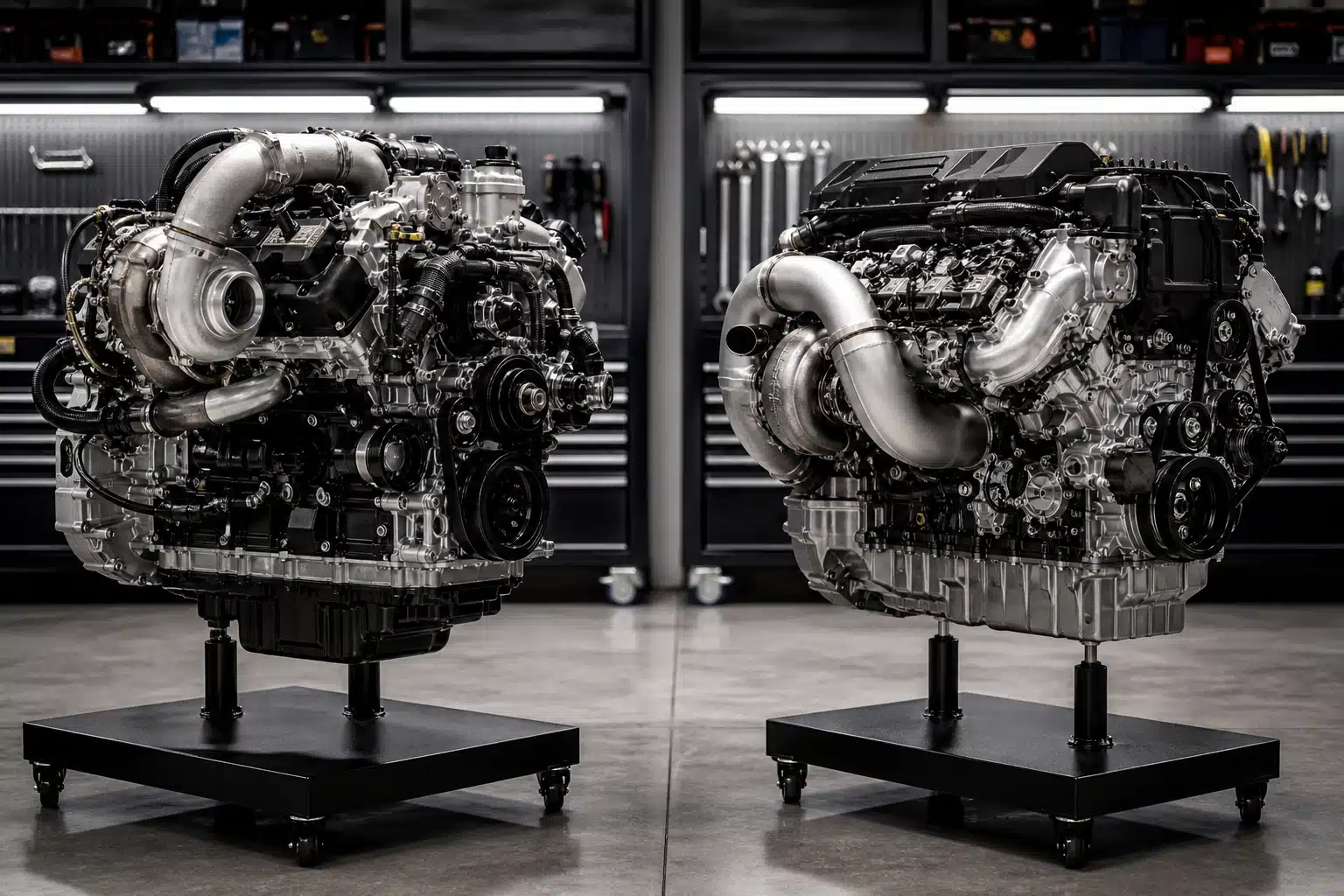
The most fundamental difference between these two engines is their layout. The Power Stroke uses a V8 configuration, while the Cummins uses an inline-six. This is not just a trivia point; it affects everything from how the engine delivers power to how long it lasts.
Power Stroke V8 Advantages:
- Compact design fits well in the Ford Super Duty engine bay
- Higher peak horsepower (500 hp vs 420 hp in standard configurations)
- Smoother idle and less vibration at low RPMs
- Lighter overall engine weight
Cummins Inline-Six Advantages:
- Fewer moving parts means less that can go wrong over time
- Legendary longevity (commonly reaching 300,000 to 500,000+ miles)
- Simpler design makes certain repairs more accessible
- Strong low-end torque delivery for heavy towing
For buyers who plan to keep their truck for 200,000 miles or more, the Cummins inline-six has a well-earned reputation for outlasting almost everything on the road. For buyers who value horsepower and refinement, the Power Stroke V8 delivers a more polished driving experience.
Towing and Payload: Where It Counts
Most people buying a diesel truck need serious towing capability. Here is how the two engines stack up in their respective trucks:
Ford Super Duty (6.7L Power Stroke):
- Max conventional towing: up to 24,000 lbs (F-350)
- Max fifth-wheel/gooseneck towing: up to 40,000 lbs (F-450)
- Max payload: up to 7,850 lbs (F-350 Regular Cab)
Ram Heavy Duty (6.7L Cummins):
- Max conventional towing: up to 20,000 lbs (Ram 3500)
- Max fifth-wheel/gooseneck towing: up to 37,100 lbs (Ram 3500)
- Max payload: up to 7,680 lbs (Ram 3500 Regular Cab)
On paper, the Ford Super Duty edges out the Ram in maximum towing numbers. However, these max ratings come with specific configurations (cab style, bed length, axle ratio, tire size). In real-world usage, both trucks handle the vast majority of towing scenarios with ease. If you are pulling a 30-foot travel trailer, a boat, or a landscape trailer full of equipment, either engine will get the job done without breaking a sweat.
Where the Cummins often gets the edge is in how the torque feels when towing. That inline-six delivers massive low-RPM torque in a very linear, predictable way. Power Stroke drivers love the V8’s responsiveness and the 10-speed automatic’s gear selection, which keeps the engine in its power band during hill climbs.
Fuel Economy: Dollars Per Mile
Diesel fuel is not cheap in Texas, so fuel economy matters for any truck buyer doing serious miles. Neither engine will win any green awards, but there are real differences:
- Cummins: Typically delivers 15 to 18 MPG highway when unloaded, and many owners report 12 to 14 MPG while towing moderate loads. The inline-six’s efficiency at lower RPMs gives it a slight edge in mixed driving.
- Power Stroke: Typically delivers 14 to 17 MPG highway unloaded, with 10 to 13 MPG towing. The V8’s higher horsepower means it can consume more fuel under load, though Ford’s 10-speed transmission helps keep consumption in check.
Over 20,000 miles per year, even a 1 to 2 MPG difference adds up to hundreds of dollars in fuel costs. For owner-operators or ranchers putting on serious mileage, the Cummins generally wins this category by a small margin.
Reliability and Longevity
This is where the Cummins has built its legend. The inline-six design, with its simpler construction and fewer cylinders, has a well-documented track record of reaching extremely high mileage. It is common to find Cummins-powered trucks on used lots with 250,000 or even 400,000 miles that still run strong. The engine block and internals are famously overbuilt.
The current 6.7L Power Stroke is far more reliable than some earlier Ford diesel engines (the 6.0L and 6.4L generations had well-known issues). Since 2011, the 6.7L Power Stroke has built a solid reputation. Most owners report trouble-free service well past 200,000 miles with proper maintenance. The engine’s emissions system (diesel particulate filter, DEF system, EGR) requires attention, as it does on both platforms.
Maintenance cost comparison:
- Oil changes: Both engines use approximately 13 to 15 quarts of diesel oil. Expect $100 to $150 per change at a shop. The Cummins has a slight advantage with easier filter access on some model years.
- Fuel filters: Both require regular fuel filter changes (every 15,000 to 20,000 miles). Parts cost is similar.
- DEF fluid: Both engines use DEF (diesel exhaust fluid). Consumption is roughly similar.
- Transmission: Ford’s 10-speed TorqShift and Ram’s 6-speed Aisin (or 8-speed in newer models) both require fluid changes. The Aisin 6-speed in older Ram trucks is extremely durable but shifts more deliberately.
Driving Experience and Comfort
If you are spending hours behind the wheel on Texas highways, the driving experience matters as much as the spec sheet.
Ford Super Duty with Power Stroke: The V8 idles quietly and delivers smooth, linear power. The 10-speed automatic shifts quickly and keeps the engine in the optimal range. Ford’s cab and suspension have improved dramatically in recent years, and the available adaptive steering and Pro Trailer Backup Assist make the Super Duty a very capable daily driver.
Ram Heavy Duty with Cummins: The Cummins has a distinctive diesel rumble that fans love. The Ram’s interior, especially in Laramie and Limited trims, is widely considered the most luxurious in the segment. The available rear air suspension provides a comfortable ride whether loaded or empty. The Cummins paired with the Aisin transmission delivers a workmanlike, predictable driving feel.
If interior luxury and ride comfort are priorities, the Ram has traditionally held an edge. If you want a more refined powertrain feel with quick-shifting gears, the Ford Power Stroke and 10-speed combination is hard to beat.
Aftermarket and Custom Build Potential
At Cars and Pickups, we specialize in custom truck builds with premium aftermarket components. Both engines have massive aftermarket support, but in slightly different ways:
- Cummins: The inline-six is a tuner’s dream. Its simple layout makes power upgrades more straightforward. The aftermarket for Cummins performance parts (turbo upgrades, intake manifolds, exhaust systems) is enormous. Many of our custom Ram builds feature delete kits and tuning that unlock significant additional power.
- Power Stroke: The 6.7L Power Stroke also has strong aftermarket support, though its V8 layout and Ford’s proprietary electronics make some modifications more complex. Cold air intakes, exhaust upgrades, and EGR solutions are popular modifications on our custom Super Duty builds.
Both platforms pair beautifully with lift kits from brands like Rough Country, custom wheels from Fuel and Cali Offroad, and aggressive tires from Toyo and Fury. The choice between Power Stroke and Cummins rarely limits your build options.
Resale Value in Texas
Texas is diesel truck country, and both engines hold their value exceptionally well. However, there are some differences worth noting:
- Cummins-powered Rams tend to command a premium on the used market, especially trucks with lower mileage. The Cummins name alone adds value, and buyers actively seek them out. A well-maintained Ram 2500 Cummins with 100,000 miles can sell for significantly more than its gas-powered equivalent.
- Power Stroke Fords also hold strong resale value, particularly the F-250 and F-350 in popular trim levels (Lariat, King Ranch, Platinum). Ford’s brand loyalty in Texas is massive, and the Super Duty consistently ranks among the best-selling vehicles in the state.
If you are buying used and plan to sell in a few years, either engine will retain value well. The key is maintenance records and overall truck condition, not just the engine badge.
Which Engine Should You Choose?
Choose the Power Stroke if:
- You need maximum towing capacity (especially with gooseneck/fifth-wheel setups)
- You want the latest transmission technology (10-speed automatic)
- You prefer a smoother, quieter diesel driving experience
- You are loyal to the Ford Super Duty platform and its available features
Choose the Cummins if:
- Longevity is your top priority and you plan to put on serious mileage
- You want the most fuel-efficient diesel option for daily driving
- You value simplicity and a proven inline-six engine design
- You plan to do performance modifications down the road
- You want the most luxurious interior in the heavy-duty segment (Ram Laramie/Limited)
See Both Options in Person
The best way to decide between Power Stroke and Cummins is to drive them. At Cars and Pickups, we carry a large selection of both Ford Super Duty and Ram heavy-duty trucks across our three Texas locations in Dallas/Addison, Austin/Kyle, and Houston/Katy. Many of our trucks feature custom builds with premium lifts, wheels, and tires already installed.
With no hidden dealer fees, no pressure sales, and no haggle pricing, you can compare both engines side by side and drive home in the diesel truck that fits your needs.
Frequently Asked Questions
Is the Cummins or Power Stroke more reliable?
Both engines are highly reliable in their current 6.7L generations. The Cummins inline-six has a longer historical track record for extreme mileage (300,000+ miles), while the 6.7L Power Stroke has proven itself as Ford’s most dependable diesel since its 2011 introduction.
Which diesel engine gets better fuel economy?
The Cummins typically delivers slightly better fuel economy, especially in highway cruising and mixed driving scenarios. Expect 1 to 2 MPG better from the Cummins on average compared to the Power Stroke.
Can I tow more with a Power Stroke or Cummins?
Ford Super Duty trucks with the Power Stroke currently offer higher maximum towing ratings than Ram trucks with the Cummins. However, for most real-world towing scenarios, both engines provide more than enough capability.
Which diesel truck holds its value better in Texas?
Both hold excellent resale value in Texas. Cummins-powered Rams often command a slight premium specifically because of the engine’s reputation, while Ford Super Duty trucks benefit from strong overall brand loyalty.
What about the Duramax?
GM’s 6.6L Duramax (found in Chevrolet Silverado HD and GMC Sierra HD trucks) is a strong competitor in the diesel truck market. While this article focuses on Power Stroke vs Cummins, the Duramax is worth considering if you are open to all three brands. Check our full inventory to see what is currently available.